
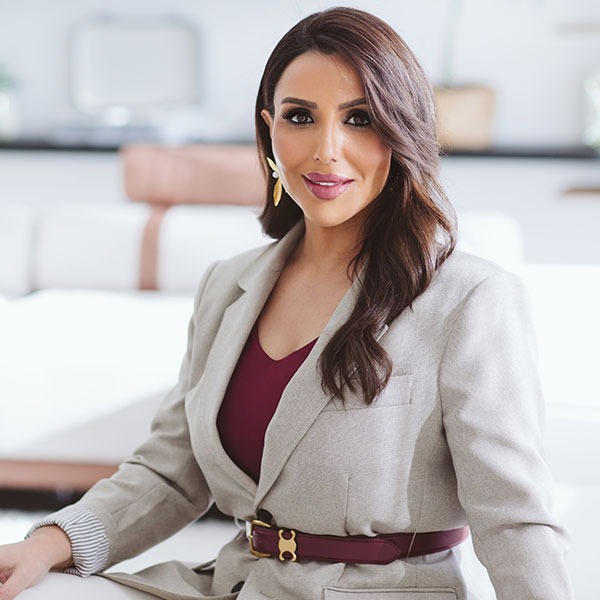
Sanaa Ouahmane
CEO, AWR Mobility, and WBD’s Mobility Ambassador

An Ode to the Women Who Spoke Up
In 2025, something shifted. Not because a policy changed or a slogan went viral, but because women spoke clearly, confidently, and on their own terms. And when women speak with purpose, cultures move.
For years, progress in our region was measured against external standards. Success was validated through alignment elsewhere. Legitimacy came from comparison. But over the last decade, and unmistakably in the last year, that reference point has changed. Today, some of the most compelling ideas shaping business, leadership, and ecosystems are not imported. They are homegrown. They come from the UAE, from the GCC, from the Arab world. They are shaped by our values, strengthened by our faith, and refined by coexistence with people of different backgrounds who share a belief that progress does not require losing identity.
Women have been at the center of this transformation. Not by copying existing feminist models, and not by rejecting them either, but by asking a more difficult and honest question: what does empowerment actually look like here? The answer was not radical individualism or separation for the sake of separation. It was not a battle narrative that frames success as a zero-sum game.
The answer was alignment. In our societies, strength has never come from standing alone. It has come from standing grounded, understanding context, and knowing when to push, when to partner, and when to lead without noise. This is where a distinct Arab feminist model found its voice. In many global narratives, men were framed as obstacles to women’s success, as barriers to ambition, or as default adversaries. That framing never reflected my reality.
I did not succeed by fighting men. I succeeded by working with them, by seeing them as contributors and partners in building outcomes that mattered. That perspective did not dilute my leadership. It sharpened it. When women stop shrinking themselves to fit narratives that were never written for them, and when men are invited to be part of the solution rather than cast as the problem, something powerful happens. Respect replaces resistance.
Trust replaces defensiveness. Leadership becomes sustainable. In 2025, this shift became visible across boardrooms, industries, and institutions. Women spoke with clarity instead of caution. Men listened with curiosity instead of fear. The result was not tension. It was progress. This is how cultures evolve. What makes this moment different is not volume, but intention. Arab women are no longer borrowing language that does not belong to them.
They are telling their stories as they are, with realism, ambition, and pride. They speak about success without apology, about motherhood without justification, and about leadership without disguise. They are redefining what it means to rise without abandoning responsibility, to lead without losing identity, and to build without burning bridges. This is not a movement built on reaction.
It is built on reflection. It also did not happen in isolation. Platforms matter when voices are ready to rise. Organizations such as Women Board of Directors played a critical role by creating space where women could lead, influence, and govern across sectors that were previously overlooked. I carry deep pride in contributing to this journey as the first Mobility Ambassador, not as a symbol, but as a responsibility. Representation without access means little.
What moves systems is credibility, execution, and continuity. Yet the true power of this movement does not sit at the top. It lives with the woman who spoke up for the first time in a meeting, with the manager who challenged a decision respectfully but firmly, with the entrepreneur who refused to dim her ambition to stay comfortable, and with the junior executive who decided her voice was worth hearing. Empowerment is not reserved for titles.
Silence has never protected women. It has only delayed them. As we look toward 2026 and beyond, the mission is clear. Speak up, not to be louder than others, but to be truer to yourself. Not to imitate confidence, but to practice it. Not to compete for space, but to expand it. The Arab world does not need borrowed narratives. It needs honest ones. Voices rooted in values, leadership shaped by responsibility, and ambition guided by purpose. We are no longer waiting to be recognized. We are shaping the standard.
To every woman who spoke up in 2025, you changed the tone of the room. To every woman still hesitating, your moment is not coming. It is here. The future of women empowerment in this region will not be defined by how closely it resembles another model, but by how faithfully it reflects who we are. And the next chapter will not be written by a few voices at the top. It will be written by many. It begins the moment you decide to speak.